
Sync BPMN models between ARIS and SAP® Cloud ALM
Maintaining a competitive business edge in an uncertain global market is a constant challenge. Deglobalization, regulation, supply chain insecurity, plus pressure to add new technology and business models (essential in the fight for competitive advantage) are all compelling businesses to improve efficiency and keep costs down.
It’s no wonder C-level executives today are highly motivated to tackle business process efficiency head-on, increasingly aware that the success of their organization depends on their processes. Dimension Data reports that 81% of organizations view business process management (BPM) as a competitive differentiator.1
Effective process management plays an important part in helping businesses to build an agile and future-ready enterprise that can adapt to stay ahead of the disruption and competition. But getting a complete picture of an organization’s siloed, fragmented processes gets more complex by the day.
Overcoming organizational challenges
This is easier said than done: For businesses trying to understand their process reality and uncover opportunities for improvement, there are some organizational barriers that can block the path to creating an end-to-end process flow.
Executing a single process can involve multiple systems, applications, people, and whole business units. Often, organizations are tempted to add separate process management tools across several departments to solve their problems, creating a patchwork of solutions (often from different vendors). For example, a business unit using a process design tool in HR for employee onboarding, also adding process mining for warehouse management, or a compliance solution for finance, will soon find it has created siloed operations sustained by pockets of intelligence.
This inevitably leads to three organizational challenges:
This is easier said than done: For businesses trying to understand their process reality and uncover opportunities for improvement, there are some organizational barriers that can block the path to creating an end-to-end process flow.
Executing a single process can involve multiple systems, applications, people, and whole business units. Often, organizations are tempted to add separate process management tools across several departments to solve their problems, creating a patchwork of solutions (often from different vendors). For example, a business unit using a process design tool in HR for employee onboarding, also adding process mining for warehouse management, or a compliance solution for finance, will soon find it has created siloed operations sustained by pockets of intelligence.
CHALLENGES
- Growing quality and transparency requirements
- Companywide uniform process documentation and analysis tool
- Increasing IT security risks in a global environment
- Process optimization as part of an SAP release change
- Complex framework conditions in resource planning
- Complex processes with many instance
OUTCOMES
- Reduction of process runtimes from days to minutes
- Approximately 700 processes, with more than 1,000 applications in the process portal
- Workflow established for reviewing and releasing processes
- Completed ISO 9001 certification
- Secured risk tolerance and future viability with IT governance
- Improved operational excellence
- Established decision support for resource planning with Simulation
- Provided process analysis across systems and departments with Process Mining
SOLUTION
- ARIS Enterprise
Maintaining a competitive business edge in an uncertain global market is a constant challenge. Deglobalization, regulation, supply chain insecurity, plus pressure to add new technology and business models (essential in the fight for competitive advantage) are all compelling businesses to improve efficiency and keep costs down.
It’s no wonder C-level executives today are highly motivated to tackle business process efficiency head-on, increasingly aware that the success of their organization depends on their processes. Dimension Data reports that 81% of organizations view business process management (BPM) as a competitive differentiator.1
Effective process management plays an important part in helping businesses to build an agile and future-ready enterprise that can adapt to stay ahead of the disruption and competition. But getting a complete picture of an organization’s siloed, fragmented processes gets more complex by the day.
Overcoming organizational challenges
This is easier said than done: For businesses trying to understand their process reality and uncover opportunities for improvement, there are some organizational barriers that can block the path to creating an end-to-end process flow.
Executing a single process can involve multiple systems, applications, people, and whole business units. Often, organizations are tempted to add separate process management tools across several departments to solve their problems, creating a patchwork of solutions (often from different vendors). For example, a business unit using a process design tool in HR for employee onboarding, also adding process mining for warehouse management, or a compliance solution for finance, will soon find it has created siloed operations sustained by pockets of intelligence.
This inevitably leads to three organizational challenges:
Understanding process intelligence: How a unified approach helps
A high-performing business needs to be able to transform, optimize, and control its processes across the entire enterprise. This requires process intelligence to identify bottlenecks and improve operational efficiency.
Transform processes to turn vision into results
Streamlining processes optimizes resources, improves operational efficiency, and can substantially reduce costs. Studies say that business process transformation can cut indirect costs by as much as 15-20% within 18 months.5
By mapping and redesigning processes end to end, a business has the blueprint to give all stakeholders the ability to see, model, and maintain them in a central place. This provides a democratized, single source of truth, where a common understanding can be built to communicate, collaborate, and continuously improve processes. It also provides the foundation for thorough analysis, key to identifying inefficiencies and bottlenecks to make changes that minimize impact and maximize ROI. Adding process intelligence helps to identify and implement best practices for a better future performance.
Optimize your business with operational excellence
Fostering a culture of operational excellence enables the business to grow based on best practice and widen the competitive gap. A huge additional benefit is the impact this will have on an improved customer journey.
By pinpointing inefficiencies such as bottlenecks, repetitive tasks, and manual efforts, an organization can implement corrective measures and automate processes that boost the customer experience.
Control processes for resilient, secure performance
There have been many headlines in recent years focusing on compliance failures—from banking bad practices to manufacturer quality failures—all resulting in expensive fines and reputational damage. These are, at their core, process and governance failures. But having control over critical processes such as risk and cybersecurity involves having deep insights to ensure processes are really executed as intended and execution can be measured and controlled. That way a business can avoid compliance or performance issues (and avoid fines).7
Turn your process intelligence into value with ARIS.
Your company’s success depends on your processes. They are how your suppliers get paid, how new products get delivered and how you serve your customers. But gaining a comprehensive picture of these processes— and how you can improve them—is getting more challenging every day.
Inside the business, operations are siloed and complex, while rising customer expectations and regulatory compliance demand more agility. Outside, there’s intense competition with market volatility threatening continuity.
Users from the world’s largest banks, manufacturers, retail, and more trust the ARIS process intelligence suite because it offers four essential modules in one solution. These are listed below and explained in more detail in the next section.
An integrated suite of four core modules:
The ARIS process intelligence suite helps enterprises transform, optimize, and control operations with a process-centric view that connects everything. With ARIS, your business can start gaining insights and driving efficiency right away. You have the strongest modeling capability in the market plus built-in process mining, process automation and risk and compliance functionality—serving multiple process-related use-cases in one single suite.
- Process mining: Process mining supports in-depth analysis, discovery, monitoring and enhancement of business processes. It allows a business to capture process data and quickly analyze it, providing a comprehensive understanding of how its business runs. ARIS’s intuitive tools for process mining can help you identify the root causes of performance issues. From here, you can uncover opportunities for improvement giving you the ability to design, implement, and control more efficient processes with greater agility.
- Automation: Automation streamlines and enhances your business operations to increase efficiency, decrease costs, improve accuracy and ensure scalability. Examples include robotic process automation (RPA), which uses software bots to automate routine, repetitive tasks—reducing human error and freeing up valuable resources for more strategic initiatives. And end-to-end workflow management within a unified platform defines, manages and optimizes processes to ensure consistency and reliability at every stage of your operational workflows, and many more.
- Risk and compliance: Effective risk and compliance management (often referred to as governance, risk and compliance management (GRC)) ensures adherence to relevant laws, regulations and standards. This helps to avoid legal and financial penalties, protects reputations and minimizes operational risks—it is critical for ensuring that organizations operate in a responsible and sustainable manner. In combination with process mining (compliance checks), you can identify and address potential risks before they become major issues.
And they’re all infused with AI to enable the democratization of insights: The ARIS AI Companion transforms Process Intelligence into an accessible tool, lowering barriers for users and fostering valuable contributions.
See How Other Business Across The
World Find Success With ARIS
INSIGHTS LIBRARY
-
-
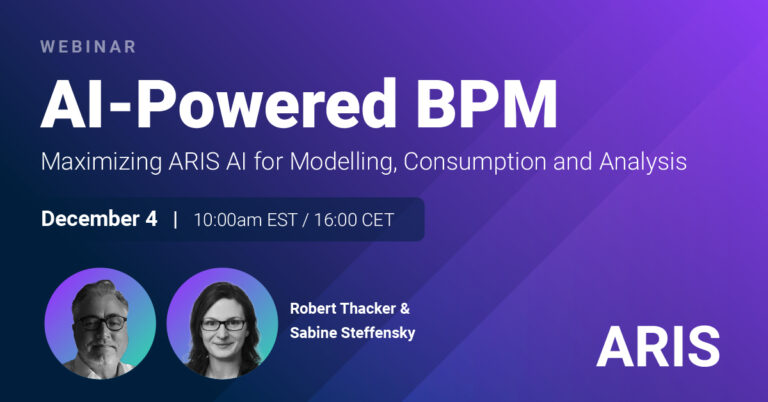
Speed up modelling, streamline search, and sharpen analysis with AI
Stay ahead with our biweekly ARIS Knowledge Sessions—your go-to space for discovering the latest features, expert tips, and practical guidance.
-

Ministry of Digital Economy and Entrepreneurship (MoDEE)
To restructure, realign and reinforce its processes, MoDEE chose to use the ARIS Process Intelligence Suite.
-
-

Australian Government Organization
How a process-driven service empowers choice for those with disabilities
-

Banco Supervielle
Banco Supervielle was founded in 1887 and is the eighth largest private capital bank in Argentina.
-
-

Multichannel Customer Experience by Lojas Lebes
Explore Lojas Lebes’ journey in creating a seamless multichannel customer experience, integrating diverse technologies for superior retail service.
-







ARTICLE
Process mining and analysis: Understand your processes like never before with ARIS Process Mining
Get a 360-degree view into how your business operates. Learn how process mining can help improve your business processes—and your bottom line.
CUSTOMER STORY
Alicorp: Unifying process architecture with ARIS
After setting an ambitious goal to unify all technologies by 2025, Alicorp needed a powerful business process management platform to empower users and encourage collaboration.
ANALYST REPORT
Everest Group’s PEAK Matrix® for Process Mining Technology Vendors – 2022
ARIS is named a Leader on Everest Group’s PEAK Matrix® for Process Mining Technology Vendors for the second year in a row.
EBOOK
Your first steps into the world of process mining
Progress occurs because of process—the search for how to do something better. Learn how process mining takes this a step further by discovering even better ways of working.

See how ARIS can strengthen your global operations
Uncover opportunities to standardize, automate, and fortify processes across global business services.
Book a demo to see how ARIS can help your business to deliver measurable impact in the face of market disruptions.
Contact us to book your free demo
* indicates a required field
By submitting this form, I confirm and agree to ARIS’s website terms and conditions and to the storing and processing of my personal data by ARIS as described in the ARIS Privacy Policy.